PET · PLA · RPET
مصنع حاويات الطعام
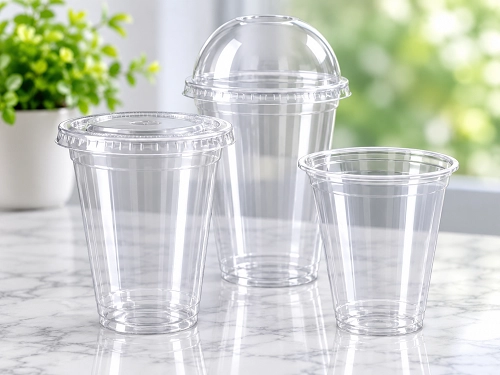
Clear PET plastic cold cups are widely used in the foodservice and beverage packaging industries because they combine excellent transparency, lightweight construction, and practical durability. From iced coffee and smoothies to fruit tea, soft drinks, and other chilled beverages, these cups allow businesses to present their products attractively while providing customers with convenient, reliable packaging.
However, selecting the right clear PET cup involves more than appearance. Material quality, wall thickness, capacity, dimensional accuracy, lid compatibility, and food-contact safety all influence the performance of the final product.
For beverage brands, restaurants, cafés, and distributors, understanding these technical factors can help reduce packaging costs, improve customer experience, and ensure consistent product quality.
Clear PET plastic cold cups are disposable beverage containers manufactured from polyethylene terephthalate (PET), a thermoplastic polymer commonly used in food and beverage packaging.
PET is particularly suitable for cold beverage applications because of its high optical clarity, relatively good stiffness, lightweight structure, and resistance to many common food and beverage ingredients.
Unlike opaque paper cups or colored plastic containers, transparent PET cups allow customers to see the beverage inside. This makes them especially popular for drinks with visually distinctive layers, toppings, fruit pieces, or colorful ingredients.
Common applications include:
Iced coffee and cold brew
Bubble tea and milk tea
Fruit tea and lemonade
Smoothies and milkshakes
Iced juice and soft drinks
Cold desserts and specialty beverages
For beverage businesses, transparency is not simply an aesthetic feature. It can also support product presentation, brand recognition, and impulse purchasing.
The performance of a clear PET cup depends largely on the characteristics of its raw material and the manufacturing process.
Understanding several important properties helps buyers evaluate whether a particular cup is suitable for their intended application.
One of PET's most recognizable characteristics is its transparency. High-quality PET cups provide a clear viewing surface that allows beverage colors, layers, and ingredients to remain visible.
This is particularly valuable for specialty drinks such as layered iced lattes, fruit teas, and smoothies.
Clarity can be influenced by raw material quality, processing temperatures, mold conditions, and the consistency of the forming process. Buyers should therefore evaluate actual finished samples rather than relying exclusively on material descriptions.
PET offers a useful balance between weight and structural stiffness.
A properly designed PET cold cup can maintain its shape during normal handling, filling, transportation, and consumption without requiring unnecessarily thick walls.
However, cup rigidity does not depend on material thickness alone. It is also affected by cup geometry, wall distribution, rim design, and forming conditions.
A cup with uneven wall thickness may deform more easily, even if its overall material weight appears sufficient.
PET has low water absorption and provides a practical barrier against liquid moisture.
This makes it suitable for holding chilled beverages without the softening associated with conventional paper packaging.
Nevertheless, condensation can form on the exterior when cold drinks are exposed to warm, humid environments. This is a natural temperature-related phenomenon rather than necessarily a material defect.
PET generally performs well with many common non-alcoholic beverage ingredients, including water, fruit juices, and acidic drinks.
However, compatibility should be evaluated according to the actual beverage formulation, temperature, contact time, and applicable food-contact requirements.
Businesses should not assume that every PET cup is suitable for every liquid or temperature condition.
Manufacturing processes have a direct impact on cup appearance, consistency, dimensional accuracy, and mechanical performance.
Most conventional clear PET cold cups are produced through thermoforming.
The process generally involves the following stages.
PET resin is processed into plastic sheets with controlled thickness and material characteristics.
For food packaging applications, manufacturers should use raw materials and processing systems suitable for the intended food-contact application.
Sheet thickness consistency is important because it influences the amount of material distributed throughout the finished cup.
The PET sheet is heated until it reaches an appropriate forming temperature.
It is then shaped using specialized molds, often with vacuum or pressure assistance.
During this stage, factors such as heating uniformity, forming pressure, mold temperature, and cycle time influence the final cup structure.
Poor process control can result in uneven walls, inconsistent dimensions, or visible forming defects.
After forming, excess material is removed to create individual cups.
The rim is particularly important because it provides structural support and serves as the contact surface for the lid.
An accurately formed rim helps improve lid compatibility and reduces the likelihood of leakage caused by poor closure fit.
Finished cups are inspected for appearance, dimensions, weight consistency, and structural defects.
Depending on the manufacturer's quality-control procedures, inspections may include:
Visual clarity and surface inspection
Cup height and diameter measurements
Rim roundness and dimensional accuracy
Wall thickness distribution
Compression or deformation testing
Lid-fitting and leakage evaluation
Consistent quality control is essential for businesses purchasing PET cups in bulk, especially when using automated filling or sealing equipment.
Choosing the right PET cup requires matching its specifications to the beverage, dispensing method, and operating environment.
The following factors deserve particular attention.
Capacity is one of the first specifications buyers should consider.
Common commercial sizes include 12 oz, 16 oz, 20 oz, and 24 oz, although available sizes vary by manufacturer and market.
Importantly, nominal capacity and actual brimful capacity are not necessarily the same.
A cup advertised as 16 oz may have a larger total capacity when filled to the rim, while its recommended serving volume leaves room for ice and a lid.
Buyers should confirm both usable filling capacity and brimful capacity before placing large orders.
Wall thickness influences stiffness, material consumption, and overall packaging cost.
A thicker cup may provide greater rigidity, but increasing thickness without considering cup design can lead to unnecessary material usage.
Instead of evaluating thickness alone, buyers should consider:
Average and minimum wall thickness
Finished cup weight
Resistance to squeezing and deformation
Performance during stacking and transportation
Suitability for the intended beverage
For high-volume beverage operations, consistent cup weight is particularly important because variations can affect both product performance and material consumption.
Cup dimensions determine compatibility with lids, dispensers, and cup holders.
The top diameter is especially important because PET cold cups are commonly paired with flat lids, dome lids, and straw-slot lids.
Even small dimensional differences can affect lid attachment.
Buyers should request technical drawings or actual samples to verify top diameter, bottom diameter, overall height, and rim design.
A cup and lid should be treated as a complete packaging system rather than two independent products.
Common lid options include:
Flat lids for standard cold beverages
Dome lids for whipped cream and toppings
Straw-slot lids for iced drinks and milk tea
Specialty lids for particular dispensing requirements
Not every lid fits every cup, even when the nominal capacity is identical.
For reliable performance, conduct fit testing using the exact cup and lid combination intended for commercial use.
PET is not the only plastic material used in disposable beverage packaging. PP and other polymers are also available, each offering different characteristics.
| Feature | PET Cups | PP Cups |
|---|---|---|
| Transparency | Generally excellent | Varies by grade and design |
| Stiffness | Generally rigid | Often more flexible |
| Lightweight design | Yes | Yes |
| Cold beverage applications | Excellent | Excellent |
| Heat resistance | Limited | Generally higher |
| Appearance | Clear, glossy finish | Can be translucent or clear |
PET is often preferred when visual presentation and structural stiffness are priorities.
PP may be more appropriate for applications requiring greater heat resistance or flexibility.
Neither material is universally better. The correct choice depends on the beverage, filling temperature, packaging requirements, and local food-contact regulations.
Food safety should be a primary consideration when purchasing clear PET plastic cold cups.
PET is widely used in food packaging, but the suitability of a finished cup depends on the specific resin, additives, manufacturing conditions, and intended conditions of use.
Commercial buyers should pay attention to the following areas.
Food-contact compliance: Confirm that the finished product meets the applicable food-contact requirements in the destination market. For example, US buyers should consider relevant FDA food-contact regulations, while European buyers should evaluate applicable EU food-contact materials legislation.
Material traceability: Ask suppliers about raw material sourcing, batch identification, and quality documentation.
Migration testing: Where required, obtain relevant overall and specific migration test reports based on the intended food type, temperature, and contact conditions.
Hygienic manufacturing: Evaluate the manufacturer's production environment, handling procedures, storage conditions, and packaging practices.
Application suitability: Confirm whether the cup is intended for refrigerated storage, room-temperature filling, or other specific operating conditions.
A supplier's statement that a product is food-grade should not replace appropriate compliance documentation and application-specific verification.
Even well-designed PET cups can experience performance problems when material selection, manufacturing, or application requirements are not properly matched.
Here are several common issues buyers should understand.
Deformation may occur when cups are exposed to excessive heat, uneven pressure, or unsuitable stacking conditions.
To minimize this problem, select a cup with appropriate rigidity and verify its performance under actual storage and filling conditions.
Loose or difficult-to-attach lids can result from dimensional inconsistencies or incompatible cup and lid designs.
The best approach is to test the complete packaging combination before purchasing in bulk.
Cloudiness, scratches, or inconsistent surface appearance can affect product presentation.
These issues may be associated with raw material quality, forming conditions, surface contamination, or handling.
Suppliers should maintain consistent production parameters and appropriate packaging protection.
A weak rim or uneven material distribution can increase the risk of damage during handling.
Buyers should evaluate rim strength, cup flexibility, and stacking performance through sample testing.
For distributors, restaurant chains, and beverage packaging brands, choosing a reliable manufacturer is just as important as choosing the right material.
A competitive supplier should offer more than attractive pricing.
Consider these factors when evaluating potential manufacturers:
Manufacturing capabilities
Ask about production equipment, thermoforming technology, mold availability, production capacity, and experience with different cup sizes.
Product consistency
Request samples from actual production batches and compare cup dimensions, weight, transparency, and lid compatibility.
Customization options
Depending on the supplier's capabilities, customization may include cup capacity, dimensions, wall thickness, printing, packaging specifications, and private-label requirements.
Quality management
Ask about inspection procedures, production records, defect control, and traceability.
Food-contact documentation
Request applicable compliance declarations and supporting test reports for the destination market.
Supply reliability
Evaluate minimum order quantities, production lead times, packaging methods, shipping arrangements, and the supplier's ability to support repeat orders.
A reliable manufacturer should be able to explain technical specifications clearly and provide practical recommendations based on the buyer's application.
Standard PET cold cups are primarily designed for cold beverages. They should not be used for hot drinks unless the specific product has been tested and explicitly approved for the intended temperature.
High temperatures can cause deformation and compromise packaging performance.
PET is a widely recycled plastic, commonly identified by resin identification code No. 1.
However, actual recyclability depends on local collection systems, sorting facilities, contamination levels, cup design, and applicable recycling policies.
Businesses should check local recycling guidelines rather than assuming all disposable PET cups will be recycled.
PET generally has good resistance to many common acidic beverages, including fruit juices and lemon-based drinks.
However, compatibility should be confirmed for the actual formulation and intended storage conditions.
A 16 oz nominal serving cup may not hold exactly 16 fluid ounces when filled to the rim.
Manufacturers may distinguish between serving capacity and brimful capacity. Buyers should clarify which measurement is used in product specifications.
Many manufacturers offer customization options, depending on their production equipment and order quantities.
Possible options include different capacities, dimensions, printing designs, packaging configurations, and compatible lid styles.
Buyers should confirm available customization options, minimum order quantities, tooling requirements, and production lead times before ordering.